
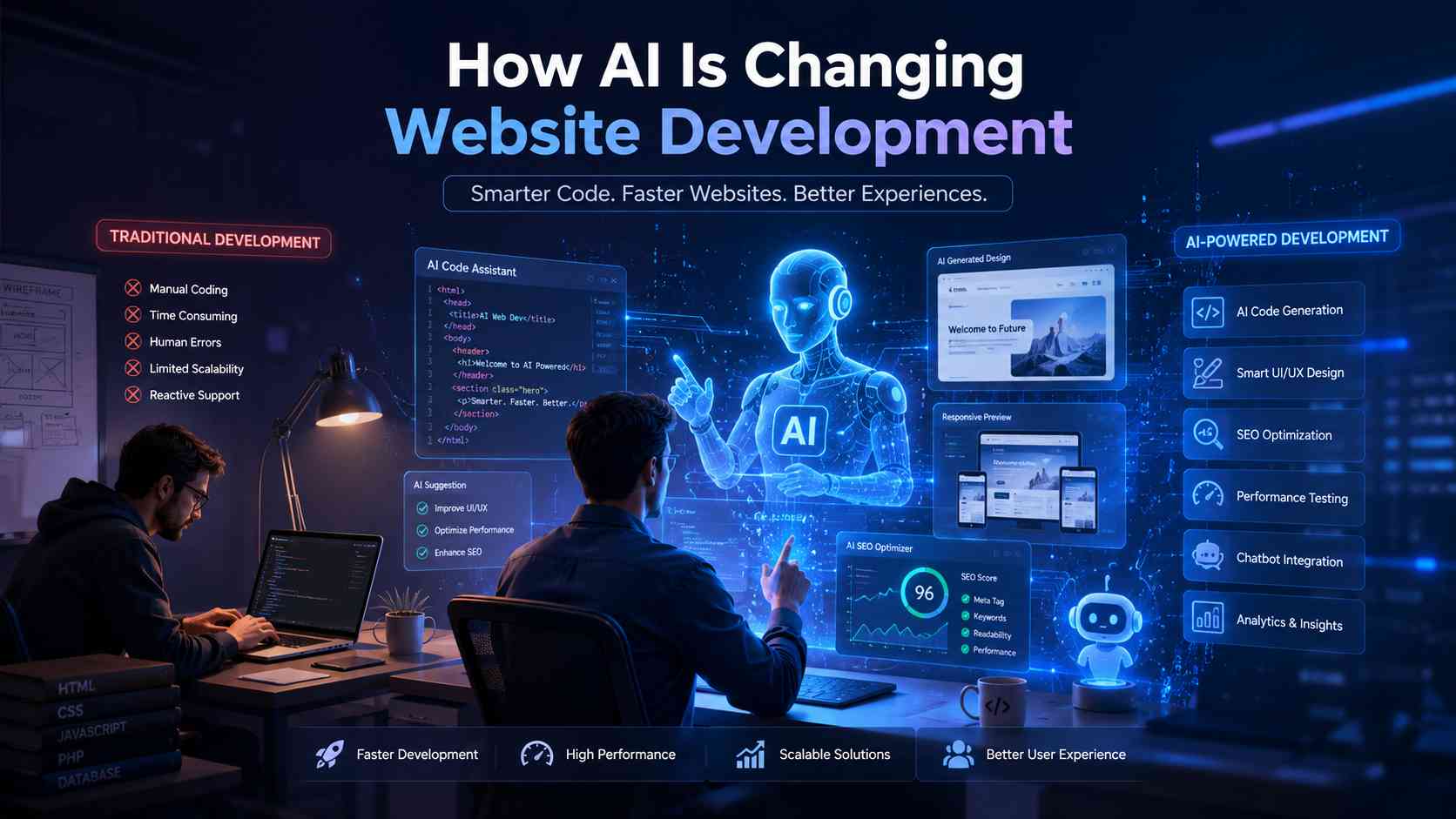
How AI Is Changing Website Development for Ecommerce Stores
In the fast-paced world of ecommerce, your website is your most valuable asset. It’s the digital storefront where customers browse, compare, and buy. But building and maintaining a high-performing online store has traditionally required significant time, technical skill, and budget. Enter artificial intelligence. Today, website development is being transformed by AI, making it faster, more intuitive, and more profitable for merchants of all sizes. In this post, we’ll explore exactly how AI is changing the game—and how you can use it to build a better ecommerce site.
What Is AI-Powered Website Development?
AI-powered website development refers to the use of machine learning, natural language processing, and automation tools to assist in creating, designing, optimizing, and maintaining websites. Unlike traditional development, which relies heavily on manual coding and human decision-making, AI introduces speed, personalization, and data-driven insights. For ecommerce merchants, this means you can launch a site faster, update it more easily, and deliver a shopping experience that feels tailored to each visitor.
From Static Pages to Intelligent Experiences
In the past, building an ecommerce site meant choosing a template, writing product descriptions, and hoping for the best. AI shifts this paradigm by enabling dynamic content. For example, AI can analyze user behavior in real-time and adjust product recommendations, layout, or even color schemes to match individual preferences. This is not just a trend—it’s a fundamental shift in how website development approaches user experience.
Key Ways AI Is Transforming Website Development for Ecommerce
Let’s break down the most impactful changes AI brings to the table, with actionable advice for your store.
1. Automated Code Generation and Prototyping
One of the most time-consuming parts of website development is writing code from scratch. AI tools like GitHub Copilot and ChatGPT can now generate HTML, CSS, JavaScript, and even backend scripts based on simple prompts. For ecommerce merchants, this means you can prototype a landing page, checkout flow, or product grid in minutes rather than days.
Actionable Tip: Use AI code assistants to generate responsive product card layouts or custom filter options. Always test the output for security and performance, but let AI handle the repetitive coding tasks.
2. Intelligent Design Assistance
Designing a visually appealing ecommerce site that converts is an art and a science. AI-powered design tools like DALL·E, Midjourney, or Wix ADI can generate unique graphics, suggest color palettes, and even create full page mockups. More advanced platforms analyze your brand style and audience to recommend design elements that drive engagement.
Actionable Tip: Use an AI design assistant to create A/B test variations of your homepage hero section. Let it generate two to three options, then test which layout yields higher click-through rates.
3. Personalized User Experiences at Scale
Personalization is a cornerstone of modern ecommerce, and AI makes it scalable. Instead of manually segmenting your audience, AI algorithms analyze browsing history, purchase patterns, and even mouse movements to tailor the shopping experience. This can include personalized product recommendations, dynamic pricing, and customized email pop-ups.
Actionable Tip: Implement an AI personalization engine (like Nosto or Dynamic Yield) on your product pages. Start with “Frequently Bought Together” suggestions and expand to personalized homepage banners based on user segments.
4. Enhanced SEO and Content Creation
Search engine optimization is critical for driving organic traffic, but it’s also a constant challenge. AI tools can now generate SEO-optimized product descriptions, meta titles, and blog posts in seconds. They also analyze search trends and competitor data to suggest keywords you might have missed. This directly impacts your website development strategy because content is a core part of your site’s structure.
Actionable Tip: Use an AI writing tool to create unique product descriptions for every SKU. Then, run an AI-powered SEO audit (like with Semrush or Ahrefs) to identify gaps in your site’s keyword coverage.
5. Faster Bug Detection and Quality Assurance
No ecommerce site is perfect at launch. Bugs in the checkout process, broken links, or slow loading times can kill conversions. AI-driven testing tools simulate thousands of user journeys to find errors faster than any human team. They can also predict where issues might arise based on code changes.
Actionable Tip: Integrate an AI-based QA tool into your website development workflow. Run automated tests every time you update product pages or add new features. This reduces downtime and improves customer trust.
6. Chatbots and Customer Support Integration
While not a direct part of development, AI chatbots are now deeply integrated into ecommerce sites. They handle customer inquiries, guide users through the purchase process, and even upsell products. Modern chatbots use natural language processing to understand complex questions and provide human-like responses.
Actionable Tip: Add an AI chatbot to your store’s product pages and cart. Train it on your FAQs and return policies. Monitor its performance and refine responses weekly to improve customer satisfaction.
Practical Steps to Implement AI in Your Website Development
Ready to leverage AI? Here’s a simple roadmap for ecommerce merchants.
Step 1: Audit Your Current Development Process
Identify bottlenecks. Is it design? Coding? Content creation? List the tasks that take the most time and have the highest error rates. These are prime candidates for AI automation.
Step 2: Choose the Right AI Tools
Don’t try to implement everything at once. Start with one area, such as AI-generated product images or an AI SEO assistant. Research tools that integrate with your existing platform (Shopify, WooCommerce, Magento, etc.).
Step 3: Train Your Team
AI tools are only as good as the humans using them. Invest time in learning how to prompt AI effectively. For example, instead of asking “write a product description,” be specific: “Write a 50-word product description for a blue cotton T-shirt, focusing on comfort and durability, targeting eco-conscious shoppers.”
Step 4: Test and Iterate
AI is not set-and-forget. Monitor performance metrics like conversion rate, page load speed, and user engagement. Adjust your AI settings based on real data. For instance, if an AI-generated design lowers bounce rate, keep it. If not, revise the prompt or switch tools.
Step 5: Prioritize Security and Compliance
AI tools often process customer data. Ensure your website development practices comply with GDPR, CCPA, and other regulations. Use AI to enhance security (e.g., fraud detection) but never at the expense of user privacy.
Common Pitfalls to Avoid with AI in Development
While AI offers immense benefits, there are traps to watch for:
- Over-reliance on AI: AI can generate code and content, but it lacks context. Always review and test AI outputs for brand voice and accuracy.
- Ignoring user experience: Don’t let AI make all design decisions. Human intuition about your customers is still vital.
- Neglecting mobile optimization: AI-generated designs may not automatically be mobile-friendly. Always check responsiveness.
- Underestimating costs: Some AI tools have subscription fees. Calculate ROI before committing.
Future Trends: Where AI and Website Development Are Heading
The evolution is far from over. Expect to see AI that can build entire ecommerce stores from a single conversation prompt, real-time multilingual translation for global sales, and predictive analytics that anticipate inventory needs. For merchants, staying ahead means embracing AI as a core part of your website development strategy today.
FAQ: AI and Website Development for Ecommerce
Can AI replace human web developers entirely?
No. AI excels at repetitive tasks, code generation, and data analysis, but it cannot replace strategic thinking, creative branding, or nuanced customer understanding. The best approach is to use AI as a powerful assistant to your development team.
Is AI website development expensive?
It varies. Basic AI tools for content generation or design can cost as little as $20/month. More advanced platforms for personalization or automated testing may run hundreds per month. However, the time saved often justifies the investment.